

Cart
0
Plain white PLA gets the job done. But if you've ever pulled a finished print off the bed and thought "this looks exactly like every other print I've made," you already know that filament choice is where creativity either starts or stops.
Specialty filaments — the ones that glow, shift color with heat, or come bundled in multiple hues for longer runs — aren't gimmicks. They change what a single-extruder printer can produce without any post-processing paint or multi-material setup. The trick is knowing which type actually fits your use case, because they behave differently on the printer and serve very different end goals.
The Three Types Worth Knowing
1. Silk Glow-in-the-Dark (Multicolor Rainbow)
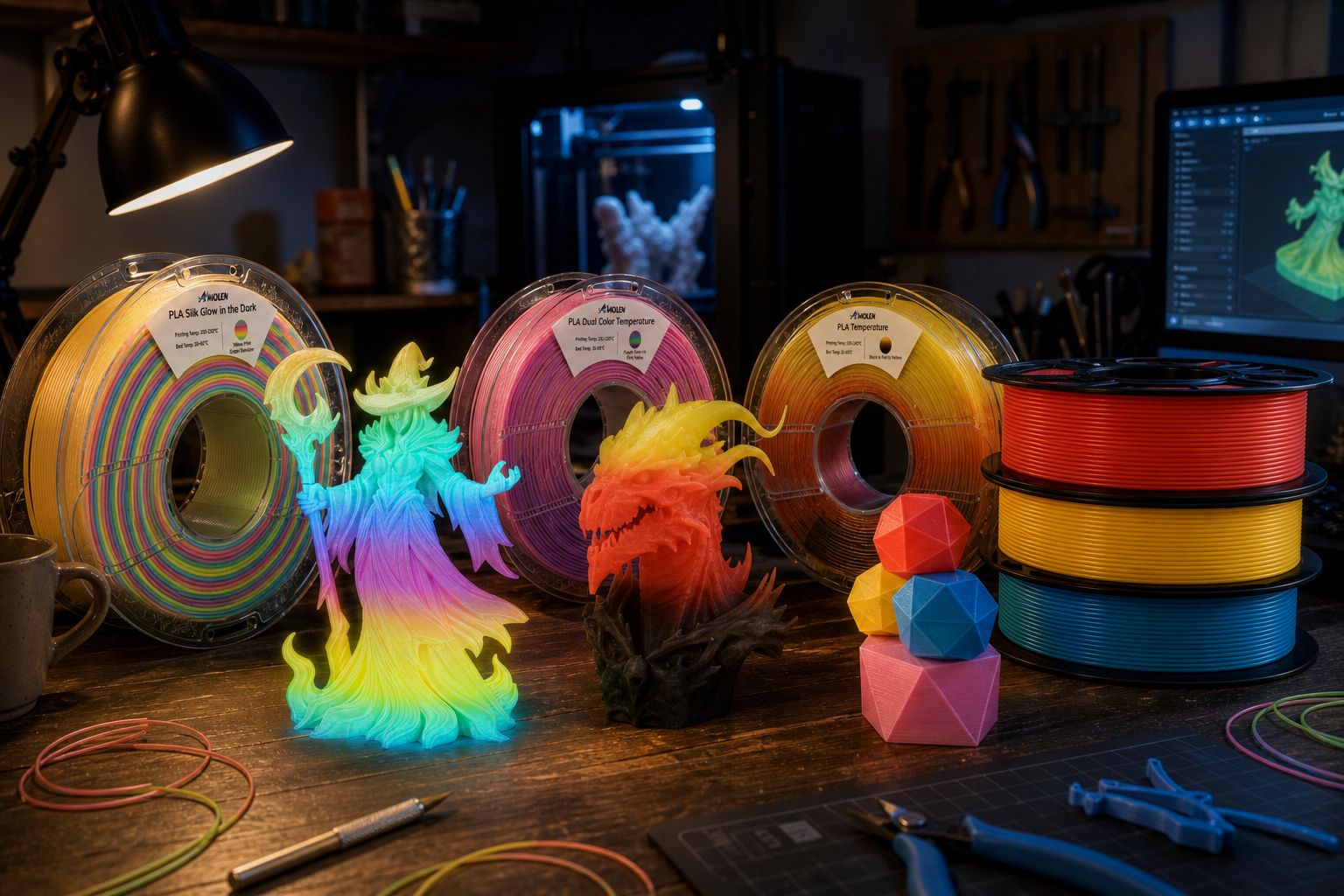
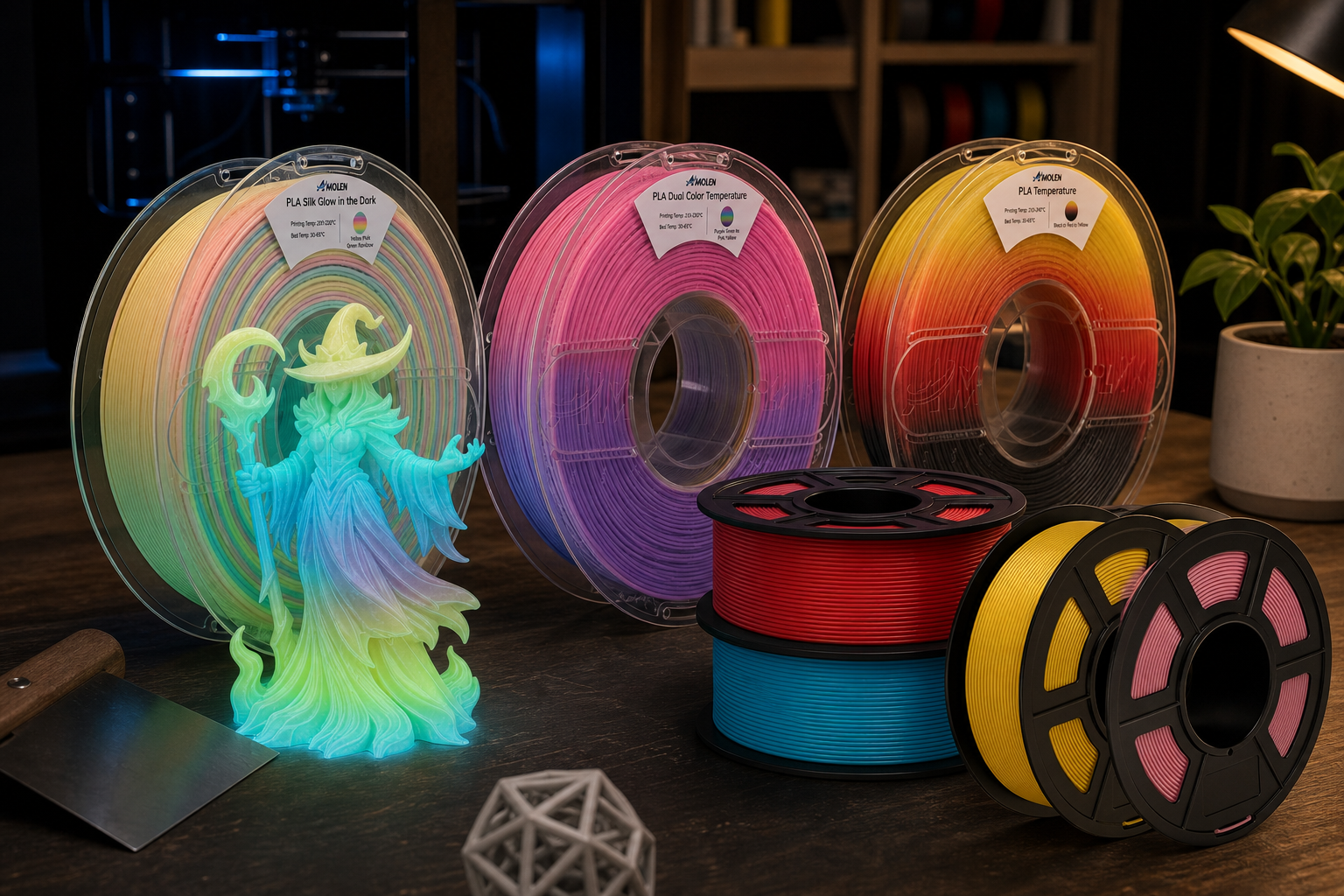
The AMOLEN Glow in The Dark Filament PLA Silk Glow 3D Printer Filament combines two effects in one spool: a shiny, silk-like surface finish and a rainbow gradient that shifts across yellow, pink, and green tones. In normal light, prints have that glossy, almost resin-like sheen that makes layer lines nearly disappear visually. In the dark, the phosphorescent pigments activate and the piece glows.
This is the filament for display pieces — fantasy miniatures, decorative props, cosplay accessories, or anything you want to look dramatically different under different lighting conditions. The gradient means color transitions happen naturally as the print builds height, so a tall figure will show a genuine rainbow progression without any slicer tricks.
One thing to be realistic about: glow-in-the-dark filaments need UV or bright light exposure to charge the phosphorescent effect. The glow intensity and duration depend on how long the piece was exposed to light beforehand — it's not a permanent backlight. Great for a shelf display near a window; less dramatic in a perpetually dim room.
2. Temperature-Reactive Dual and Triple Color Change
These are the filaments that genuinely surprise people the first time they see them in action. Thermochromic pigments embedded in the PLA respond to temperature, shifting the print's color based on whether it's warm or cool.
The AMOLEN Dual Color Temp Change PLA Filament transitions between purple-green and pink-yellow depending on temperature. Hold it in your hands, set it near a warm lamp, or take it outside on a cold day — the color shifts. It's a dual-change, meaning two distinct color states.
The AMOLEN Triple Color Temp Change PLA Filament goes a step further with three states: black at cold temperatures, transitioning through red, and into yellow at higher temperatures — essentially the color palette of a fire, which makes it a natural choice for dragon prints, flame effects, and similar fantasy subjects. The photo shows exactly this: a dragon head that graduates from dark charcoal at the base to vivid orange and yellow at the crown, all from a single spool.
Both are 1.75mm PLA at their core, so they print on any standard FDM machine without exotic settings. The color-change behavior is purely a display property — it doesn't affect layer adhesion or print strength compared to standard PLA. Where they shine is interactive objects: a mug sleeve that changes color with a hot drink, a phone stand that shifts when the phone warms up, a prop that reacts to body heat.
3. PETG Bundle for Functional, Long-Run Printing
Not every project needs drama. Sometimes you need a filament that survives in a car dashboard, holds up to repeated use, or just needs to be a reliable workhorse across a big batch of prints in multiple colors.
The JAYO PETG Filament 1.75mm Bundle is the practical option in this group. It's a 4.4KG bundle across four colors — yellow, pink, sky blue, and cherry red — with a stated dimensional accuracy of +/- 0.02mm, which matters for parts where fit and tolerance are important. PETG sits between PLA and ABS in terms of properties: tougher and more heat-resistant than PLA, easier to print than ABS, and with better layer adhesion than either for functional parts.
The bundle format makes sense if you're running a small print farm, stocking up for a long project, or just want variety without ordering four separate spools. PETG's slight flexibility compared to PLA also means printed clips, brackets, and snap-fit parts are less likely to crack under stress.
How to Match Filament to Your Project
The honest framework is simpler than most buying guides make it:
- Display piece, prop, or miniature? The silk glow or temperature-change AMOLEN filaments will make it look like it took far more effort than it did.
- Interactive or novelty object? Temperature-change PLA is the move — dual-color for subtlety, triple-color for dramatic effect.
- Functional part, enclosure, or anything that needs to handle real-world stress? PETG. The JAYO bundle gives you enough material to run multiple iterations without running out mid-project.
- Printing for a gift or display you want to photograph well? The silk finish on the glow filament photographs beautifully — the sheen reads almost like metal or resin in photos.
One practical note: temperature-change and glow filaments are still PLA at heart, which means they share PLA's sensitivity to UV degradation over time and its lower heat resistance compared to PETG or ABS. Don't use them for parts that live in a hot car or direct outdoor sun for extended periods. For those applications, the JAYO PETG is the more sensible choice.
Settings to Keep in Mind
The spool labels visible on the AMOLEN products give you the starting point: the Silk Glow filament prints in the 200–220°C range with a bed temperature of 30–65°C. The Dual Color Temp Change runs at 210–230°C, and the Triple Color Temp Change at 210–240°C. These are standard PLA-adjacent ranges, so if your printer handles regular PLA well, these shouldn't require major adjustments. Start at the lower end of the range and dial up if you're seeing under-extrusion.
For PETG in general, slightly slower print speeds and a higher nozzle temperature than PLA are typical — but always defer to whatever guidance comes with the specific spool, since formulations vary.
Browse the full 3D Printers collection at Electroeshop to see current filament options and printer accessories alongside these picks.
Frequently Asked Questions
Do temperature-change filaments actually change color in everyday use, or only in extreme conditions?
They respond to relatively modest temperature differences — body heat, a warm drink nearby, or a cool room versus a warm one can trigger the shift. You don't need extreme heat or cold. The transition point varies by formulation, so the color change can happen at temperatures you'd encounter just handling the object.
Is glow-in-the-dark filament harder to print than standard PLA?
Generally no — it prints in a similar temperature range to regular PLA and doesn't require special hardware. The phosphorescent particles are fine enough that they don't cause nozzle wear the way abrasive filaments (like glow-in-the-dark ABS with coarser particles) sometimes can, but it's worth checking the manufacturer's guidance for your specific spool. A hardened nozzle isn't typically required for PLA-based glow filament.
Why choose PETG over PLA for functional parts?
PETG handles higher temperatures without deforming, has better impact resistance, and tends to be less brittle than PLA under stress. For anything that needs to flex slightly without snapping — clips, brackets, phone mounts, or parts that see regular handling — PETG is a more reliable choice. The trade-off is that it can be slightly stringier to print and may need a bit more tuning than PLA.
Can I use these filaments on any FDM 3D printer?
All four products listed here use 1.75mm diameter filament, which is the most common size for consumer FDM printers. The PLA-based AMOLEN filaments print at standard PLA temperatures, and the JAYO PETG is stated to fit most FDM 3D printers. That said, always verify your printer's max nozzle temperature and bed temperature range against the filament's requirements before loading a new spool.


