Cart
0

You've got a dead battery, a job to finish, and a charger sitting right there on the shelf. You plug in. Nothing happens. No light, no fan, no charge cycle — just silence. If that sounds familiar, you're probably not dealing with a broken charger. You're dealing with a voltage mismatch, and it's one of the most common tool-storage headaches that nobody warns you about upfront.
Multi-voltage chargers sound like a catch-all solution — and they often are — but "multi-voltage" doesn't mean "works with everything." Here's what that actually means in practice, and how to stop wasting time figuring it out by trial and error.
Why Voltage Tiers Exist in the First Place
Cordless tool brands built their ecosystems around voltage tiers because different jobs need different power levels. Compact 10.8V (sometimes labeled 12V MAX) packs are light and well-suited to drills, drivers, and smaller tools where weight matters. The 14.4V tier sits in the middle — less common now but still in circulation across older kit. Then there's the 20V MAX platform, which has become the dominant standard for full-size tools like circular saws, reciprocating saws, and impact wrenches.
The problem: these packs don't all charge the same way, even within the same brand's lineup. The connector might look identical, but the charge profile — the voltage ceiling, the current curve, the cell communication protocol — differs between tiers. A charger that's spec'd only for 20V MAX batteries won't correctly charge a 10.8V pack, even if it physically accepts the slide.
What "Multi-Voltage" Actually Means on a Li-Ion Charger
A true multi-voltage Li-ion charger detects the pack that's seated and adjusts its charge algorithm accordingly. It's not just accepting different physical form factors — it's reading the battery's cell count and communication data, then delivering the right voltage ceiling and taper current for that specific pack.
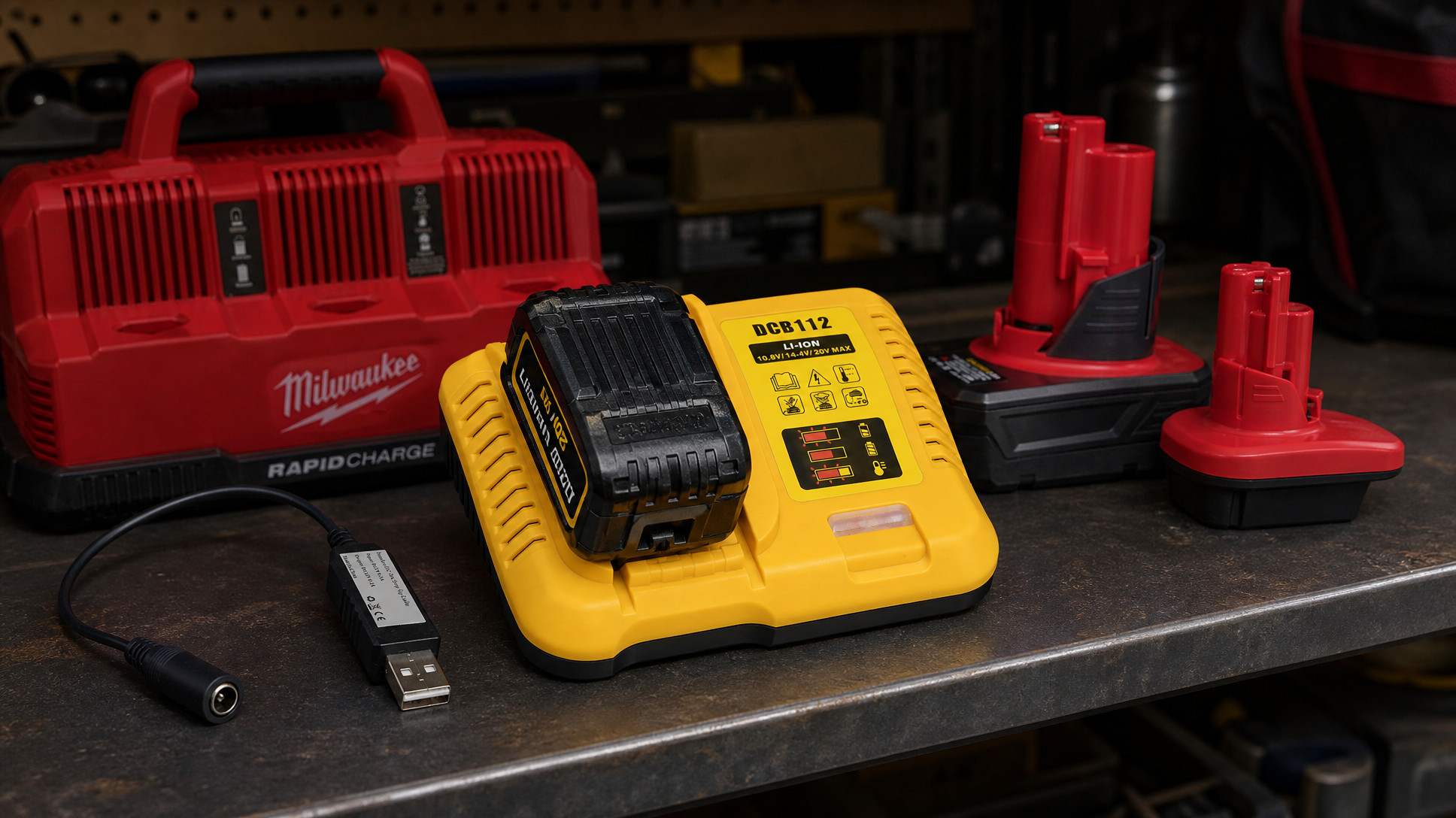
The DCB112 Battery Charger Replacement for 12V, 20V, and 60V MAX Lithium-Ion batteries is a good example of what this looks like in a compact, single-bay unit. As labeled on the unit itself, it covers the 10.8V, 14.4V, and 20V MAX range — meaning it's designed to handle the most common DeWalt Li-ion pack tiers in one charger. The yellow housing with its LED indicator panel shows charge status and temperature fault warnings at a glance, which matters more than it sounds when you've got a pack that's been sitting in a cold truck bed all morning.
What the DCB112 won't do: charge packs from a different brand's ecosystem, or packs that use a physically incompatible slide interface. Multi-voltage refers to the voltage range within a compatible battery family — not universal cross-brand compatibility.
The Mistake People Make When Upgrading Tool Kits
Here's the scenario that catches a lot of people: you've been running a 12V compact kit for years, then you add a couple of 20V MAX tools to the bench. You assume your existing charger handles both. It doesn't seat the new pack correctly, or it seats fine but never initiates a charge. You spend twenty minutes convinced the battery is dead before realizing the charger is simply out of spec for it.
The fix is straightforward: check the voltage range printed on the charger — not the tools, not the batteries, the charger itself. If your new pack's voltage isn't listed, you need a different charger. A multi-voltage unit that explicitly covers both your old and new pack tiers is the cleanest solution, and it consolidates your bench setup at the same time.
When a Single-Bay Charger Isn't Enough
A single-bay unit like the DCB112 works well if you're running one or two packs and you're not on a tight turnaround. But if you're managing a larger tool inventory — or you've got crew members pulling from a shared battery pool — a single-bay charger becomes a bottleneck fast.
That's where something like the Milwaukee M12 and M18 12V/18V Lithium-Ion Multi-Voltage 6-Port Sequential Rapid Battery Charger changes the equation entirely. The red Milwaukee unit with its carry handle and six charging ports (three M12, three M18) is built for exactly this situation. It handles both voltage tiers simultaneously, charges sequentially to manage heat and protect cell life, and the built-in handle means it travels with the job rather than staying permanently on a workbench. If you're running a mix of compact M12 tools alongside full-size M18 gear, this kind of charger removes the "which pack is charged?" guessing game entirely.
The trade-off: it's larger, heavier, and costs more than a compact single-bay unit. If you own two packs and charge overnight, it's overkill. If you own eight packs and start work at 6am, it pays for itself in avoided downtime.
Cross-Brand Compatibility: Adapters and USB Step-Up Cables
Sometimes the gap isn't between voltage tiers — it's between brands. You might own a Milwaukee-platform heated jacket but only have DeWalt chargers on hand, or vice versa. This is where adapter solutions come in.
The Smarkey Heated Jacket Adapter Charger USB Plug Cable takes a different approach: it's a compact DC-DC step-up cable with a USB-A plug on one end and a DC barrel connector on the other, designed to power or charge compatible heated jackets from brands including Milwaukee, Makita, Metabo, Craftsman, AEG, Snap-On, and Revean. It's not a battery charger in the traditional sense — it doesn't charge the tool battery pack itself — but it fills a specific gap when you need to power a compatible heated jacket from a USB power source rather than a dedicated tool charger.
Similarly, the Milwaukee M18 to M12 Battery Adapter — the red and black plastic adapter unit — lets an M18 battery slide into and power M12 tools. Again, this isn't a charger; it's a power-delivery bridge. You still charge the M18 pack on an M18-compatible charger. But for someone who's consolidating down to one battery platform and wants to keep using their older M12 tools, it's a practical way to avoid buying a second set of packs.
The key distinction worth repeating: adapters and step-up cables change how power is delivered to a tool or device. They don't replace the need for a charger that's correctly spec'd for your battery pack's voltage tier.
A Quick Reference: Matching Charger to Situation
- Single brand, 1–2 packs, occasional use: A compact multi-voltage single-bay charger (like the DCB112 for DeWalt packs) is all you need.
- Single brand, 6+ packs, professional or daily use: A multi-port rapid charger (like the Milwaukee 6-Port) removes the bottleneck and keeps your whole fleet ready.
- Mixed brands, heated apparel: A USB step-up cable like the Smarkey adapter covers the specific use case of powering compatible heated jackets from a USB source.
- Mixed Milwaukee voltage tiers (M18 packs, M12 tools): A battery adapter like the M18-to-M12 unit lets you run M12 tools from your M18 packs — no extra charger needed for the M12 side.
None of these are universal answers. The right setup depends on how many packs you're managing, which brands you're running, and how much downtime you can actually afford between charges.
Browse the full range of battery chargers and power accessories at Electroeshop to find the right charger for your voltage range and workflow — whether you're running a compact single-bay setup or managing a full multi-port fleet.
Frequently Asked Questions
Can I use a 20V MAX charger to charge a 12V battery pack?
Not safely, and usually not at all. A charger spec'd only for 20V MAX packs is calibrated for a higher cell count and a different charge profile. Even if the connector physically fits, the charger may not initiate a charge cycle for a lower-voltage pack, or it may deliver the wrong charge curve — both outcomes you want to avoid. Use a charger that explicitly lists the voltage tier of your pack on its label.
What does "sequential" charging mean on a multi-port charger?
Sequential charging means the charger prioritizes and charges packs one at a time (or in a managed order) rather than splitting its total output across all ports simultaneously. This helps manage heat buildup in the charger and in the packs, which is better for long-term cell health. It does mean a full six-port charge takes longer than six simultaneous charges would — but the trade-off is worth it for battery longevity.
Will a Milwaukee charger work with DeWalt batteries, or vice versa?
No. DeWalt and Milwaukee use different battery interfaces, communication protocols, and physical connectors. A Milwaukee charger will not accept a DeWalt pack, and a DeWalt charger won't accept a Milwaukee pack. Cross-brand compatibility requires a purpose-built adapter — and even then, most adapters are for running tools, not for charging the pack itself. Always charge each brand's battery on that brand's compatible charger.
What's the difference between a battery adapter and a battery charger?
A battery adapter lets you use a battery pack from one voltage tier (or in some cases one brand's ecosystem) to power a tool designed for a different tier — for example, an M18 pack powering an M12 tool. It doesn't charge anything; it just bridges the power connection. A charger is what replenishes the cells inside the pack. You still need the right charger for whichever pack you're using, regardless of what adapters are in your setup.