Cart
0
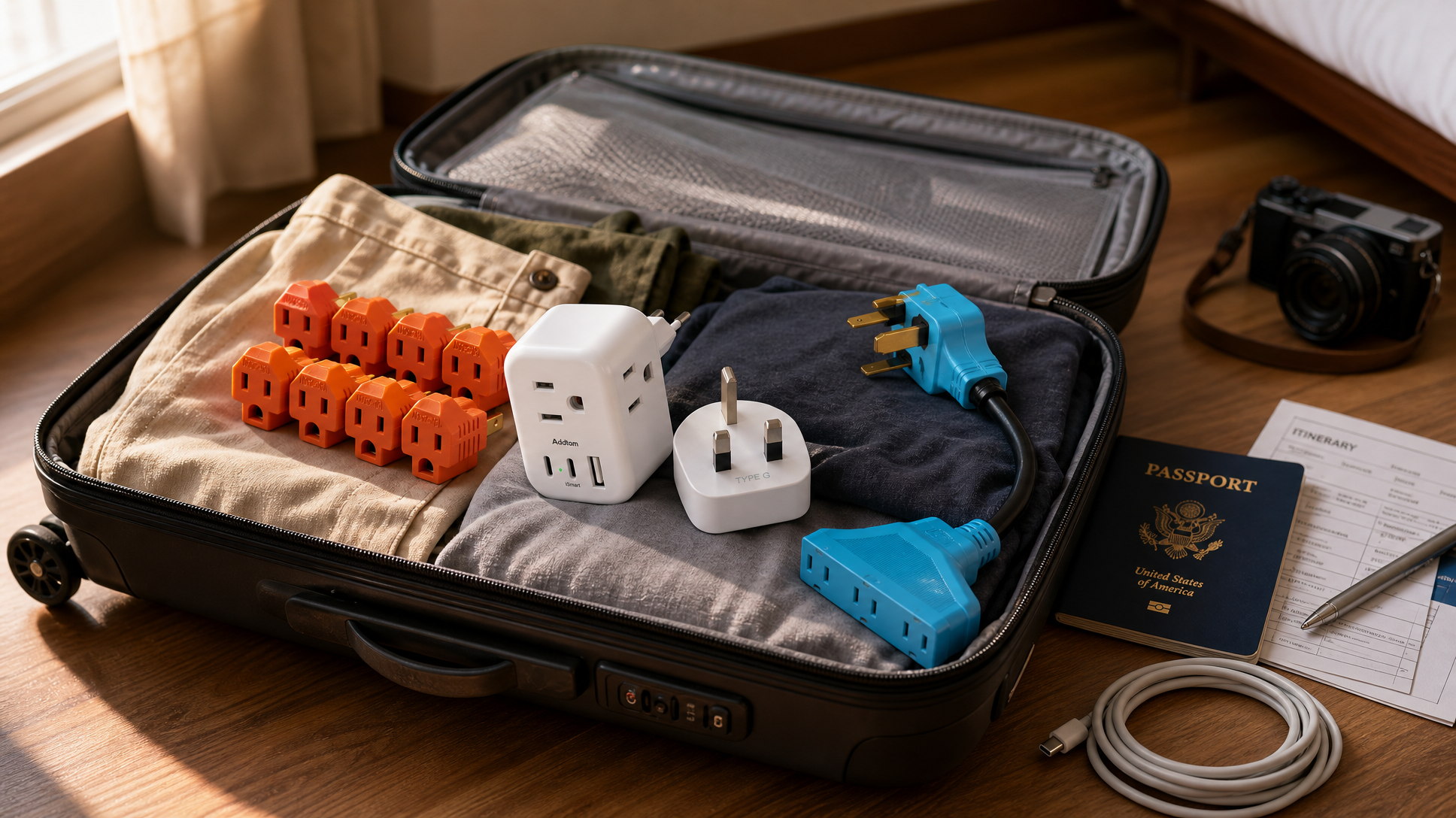
You've packed your bag, you've got your itinerary, and somewhere in a drawer you've found a little plastic adapter from a trip two years ago. You figure it'll do the job. Then you plug in your hair dryer in a Paris hotel room and — pop. The smell of burned plastic. The device is dead.
This is the most common and most avoidable travel electronics mistake there is. And it comes down to one simple mix-up: thinking an adapter and a converter are the same thing. They're not, and the difference matters more than most packing guides let on.
What a Travel Adapter Actually Does
A travel adapter changes the shape of your plug — nothing more. Different countries use different outlet designs. The US uses a flat two- or three-prong plug. Much of Europe uses the round two-pin Type C or Type E/F. The UK uses the chunky three-rectangular-pin Type G. An adapter is just a mechanical bridge that lets your US plug physically connect to a foreign outlet.
It does not change the electricity itself. The voltage and frequency coming out of that wall are exactly the same as they would be without the adapter. That's the detail people miss.
What a Voltage Converter Does
Voltage converters (sometimes called transformers) change the electrical output — typically stepping down from the 220–240V used across Europe, Asia, and most of the world to the 110–120V that US devices expect. If your device isn't built to handle higher voltage and you plug it in without a converter, you're sending roughly twice the electrical pressure through a circuit designed for half that. That's what causes the pop.
So why doesn't everyone need a converter? Because most modern electronics already handle both. Look at the fine print on your laptop's power brick, your phone charger, or your camera charger. If it says something like 100–240V, 50/60Hz, you're looking at a dual-voltage device. It self-adjusts. For those, an adapter alone is all you need.
The devices that typically don't auto-adjust: older hair dryers, curling irons, some electric shavers, small kitchen appliances, and anything with a simple motor or heating element. These are the ones that get fried.
The Quick Rule Before You Pack
Check the label on every device you're bringing. If it says 100–240V: adapter only. If it says 120V only: you need a converter too, or better yet, buy a travel-rated version of that appliance. This takes about 90 seconds and saves you from a very bad morning in a hotel room.
Choosing the Right Adapter for Where You're Going
Not all adapters cover all destinations, which is where people get caught a second time. Here are a few real scenarios and the right tool for each.
Heading to Continental Europe
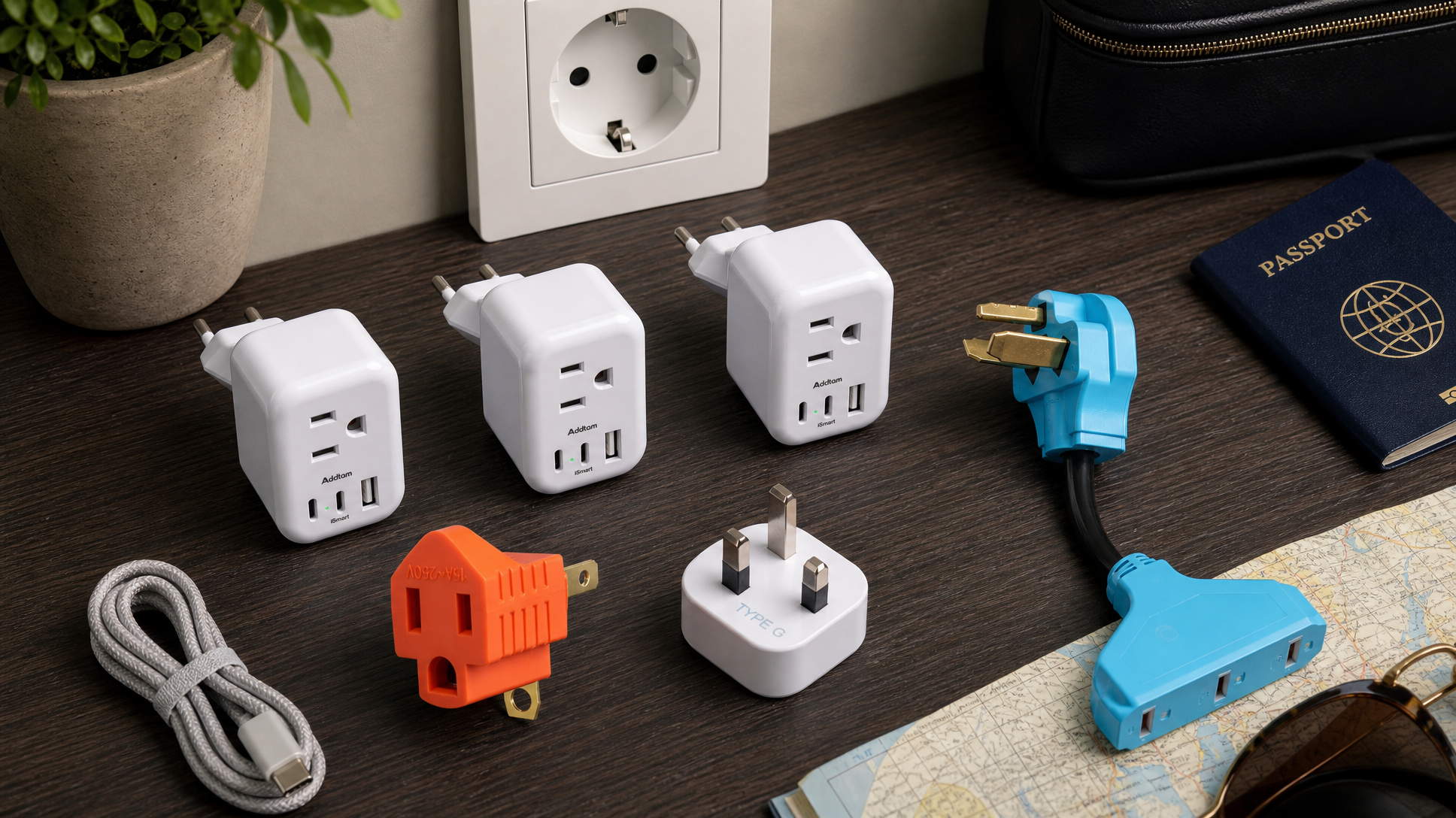
Most of Europe — France, Germany, Italy, Spain, the Netherlands — uses Type C or Type E/F round-pin outlets at 220–240V. The 3 Pack European Travel Plug Adapter by Addtam is built for exactly this. Each compact white adapter plugs into European Type C sockets and gives you three US-style outlets on the face, plus two USB-C ports and a USB-A port. If you're traveling with a partner or just loaded down with devices — laptop, phone, tablet, earbuds — you can charge everything from a single wall outlet. Because your laptop and phone chargers are almost certainly dual-voltage, the adapter handles the job without any converter needed.
Heading to the UK or Hong Kong
The UK, Ireland, Hong Kong, Singapore, and a handful of other countries use the Type G outlet — three large rectangular pins in a triangular arrangement. The Ceptics SwAdapt Type G Attachment is designed for this socket. It's a compact, white attachment-style adapter that works with the SwAdapt modular system (the base unit is sold separately). If you already own a SwAdapt-compatible device, this is the add-on that gets you into UK and Hong Kong outlets without carrying a bulky all-in-one unit.
Working in a US Workshop or Older Home
Not all adapter needs are international. The 20 Pieces 3 Prong To 2 Prong Adapter is a domestic solution — the orange, compact polarized grounding converters that let you plug a three-prong device into an older two-slot wall outlet. These are the kind of adapters you keep in a tool bag, a workshop, or an older rental property where not every outlet has been updated. The pack of 20 means you're covered for multiple rooms or job sites without hunting for a spare.
Running High-Draw Equipment from a Dryer Outlet
This one's a different category entirely but worth knowing about. The Circlecord 3 Prong 30 Amp to 110V Dryer Distribution Adapter Cord — the bright blue NEMA 10-30P to 3x 5-15R cable — lets you tap a 30-amp dryer outlet and split it into three standard 110V household outlets. This is useful for EV charging setups, workshops, or running multiple high-draw tools from a single high-amperage source. It's not a travel adapter, but it solves a real power-access problem that comes up when standard outlets simply aren't enough.
The One Mistake Worth Repeating
Buying an adapter when you need a converter is the most expensive mistake in travel electronics. But the reverse — buying a heavy, expensive converter for devices that are already dual-voltage — is just dead weight in your bag. Check the label. Two seconds of reading saves you from both errors.
For most travelers with modern gear, a good multi-region adapter (or a destination-specific one like the Addtam European pack) is genuinely all you need. Save the converter for the one device that actually requires it — or better yet, leave that device home and buy a travel-rated version.
Browse the full range of power adapters and electronics accessories at Electroeshop — including the Addtam European Travel Plug Adapter with built-in USB-C ports, the Ceptics SwAdapt Type G attachment, and more options for every outlet type and power situation.
Frequently Asked Questions
Can I use a travel adapter without a voltage converter in Europe?
Yes — if your device is dual-voltage (look for "100–240V" on its label or power brick), an adapter alone is all you need. Most laptops, phones, tablets, and camera chargers sold today are dual-voltage. The adapter just changes the plug shape so it fits the European outlet; the device handles the voltage difference on its own.
If your device says "120V only," you'll need a voltage converter as well — or consider leaving that device home and using a travel-rated alternative.
What's the difference between Type C and Type G outlets?
Type C is the standard round two-pin plug used across most of Continental Europe. Type G is the three-rectangular-pin plug used in the UK, Ireland, Hong Kong, Singapore, and a few other countries. They are not interchangeable — a Type C adapter won't fit a UK outlet, and vice versa. Always check which outlet type your destination uses before you pack.
Is it safe to use a 3-prong to 2-prong adapter?
These adapters — sometimes called "cheater plugs" — let you plug a grounded three-prong device into an older ungrounded two-slot outlet. They're widely used in older homes and workshops. The key thing to understand is that using one does not provide grounding; it simply makes the physical connection possible. For low-draw devices this is generally fine as a short-term solution, but for sensitive electronics or in permanent setups, updating the outlet to a properly grounded one is the better long-term fix.
Do I need a separate adapter for every country I visit on a multi-country trip?
It depends on your itinerary. If you're staying within Continental Europe, a single Type C/E/F adapter covers most countries. If you're adding the UK, you'll need a Type G adapter too. For trips spanning multiple regions — say, Europe plus Southeast Asia — a universal multi-region adapter that covers several plug types in one unit is usually the most practical option. Just make sure it's rated for the outlets in each country you're visiting, not just marketed as "universal."