Cart
0

Nothing kills travel excitement faster than having a brand-new power bank confiscated at the security checkpoint. It happens more often than you'd think — not because travelers are careless, but because the rules are genuinely confusing, and most product listings don't make the critical numbers easy to find.
If you're shopping for a power bank as a gift for someone who travels, or picking one up for yourself before a trip, this is the one thing you need to get right before you buy.
The Rule That Actually Matters: Watt-Hours
The FAA — the authority that sets the rules for what can fly on U.S. commercial flights — regulates portable lithium-ion batteries by watt-hours (Wh), not milliamp-hours (mAh). That's the first place most shoppers get tripped up, because power banks are almost always marketed by their mAh rating.
Here's how the FAA breaks it down, based on FAA guidance on portable electronic devices and lithium batteries:
- Under 100 Wh: Allowed in carry-on. No airline approval needed. This covers the vast majority of everyday power banks.
- 100–160 Wh: Allowed in carry-on only, but requires airline approval. Most major carriers grant this automatically, but it's worth confirming.
- Over 160 Wh: Not permitted on passenger aircraft at all — carry-on or checked.
And here's the rule that catches people off guard: power banks are never allowed in checked baggage, regardless of their capacity. Loose lithium batteries in the cargo hold are a fire risk the FAA takes seriously. If a screener finds a power bank in your checked bag, it comes out — period.
How to Convert mAh to Wh (So You Can Actually Check a Listing)
The formula is straightforward: Wh = (mAh × voltage) ÷ 1,000. Most lithium-ion power banks run at 3.7V, so a 20,000 mAh bank works out to roughly 74 Wh — comfortably under the 100 Wh limit. A 27,000 mAh bank at 3.7V lands around 100 Wh, which puts it right at the boundary where airline approval may be required.
Some manufacturers list the Wh rating directly on the product or in the specs — if they do, use that number, not your own calculation. When a listing only shows mAh and voltage isn't specified, use 3.7V as your working assumption for a standard lithium-ion cell.
The practical takeaway: if you're buying a travel gift, anything in the 10,000–20,000 mAh range at standard voltage is almost certainly fine for carry-on with no extra steps. Once you push past 26,000–27,000 mAh, start doing the math carefully.
What Form Factor Actually Travels Well
Watt-hours get you through security. Form factor determines whether the power bank is actually pleasant to travel with.
Slim, flat designs slide into a jacket pocket or the front pocket of a carry-on without bulk. If the recipient travels light or does a lot of day trips, this matters more than raw capacity.
Built-in cables — where the USB-C or Lightning connector folds out from the unit — eliminate the "where did I pack that cable?" problem entirely. They're especially good gifts for people who travel frequently and want fewer loose items to manage.
Wireless charging on a power bank sounds convenient, but it's worth knowing it charges slower than wired and drains the bank faster. For a long travel day when you need reliable top-ups, wired is still the practical choice.
Multi-port banks (one USB-C, one USB-A, for instance) let a traveler charge a phone and earbuds simultaneously — genuinely useful on a long-haul flight without adding much size.
The Gift-Buying Checklist
Before you finalize any power bank purchase for a traveler, run through these four checks:
- Find the Wh rating. Either from the product listing specs or by calculating (mAh × 3.7V) ÷ 1,000. Confirm it's under 100 Wh for hassle-free carry-on.
- Check the output wattage. A bank that supports fast charging (look for Power Delivery or Quick Charge in the specs) will top up modern smartphones much faster than a standard 5W output — a meaningful difference on a 2-hour layover.
- Match capacity to the trip type. A weekend traveler who charges their phone once a day needs far less capacity than someone on a two-week international trip. Bigger isn't always better if it adds unnecessary weight.
- Look at the physical size and weight. Check the listed dimensions and weight in the specs. A 20,000 mAh bank that weighs close to a pound is technically carry-on legal but might sit in a bag unused because it's too heavy to carry comfortably.
Also worth noting: some airlines — particularly international carriers — have their own capacity limits that are stricter than the FAA's. If the gift recipient flies a specific airline regularly, it's worth a quick check on that airline's website before purchasing a bank that sits right at the 100 Wh line.
What to Skip
High-capacity laptop power banks — the kind designed to charge a MacBook or gaming laptop multiple times — often exceed 160 Wh and are simply off the table for air travel. They're not a great travel gift unless the recipient primarily travels by car or train. Save those for home office or road trip contexts.
Similarly, power banks with built-in AC outlets (the ones with a standard wall plug) tend to be large, heavy, and often push into higher watt-hour territory. They're useful at a campsite or in a hotel room, but not ideal as a carry-on travel companion.
Where to Shop
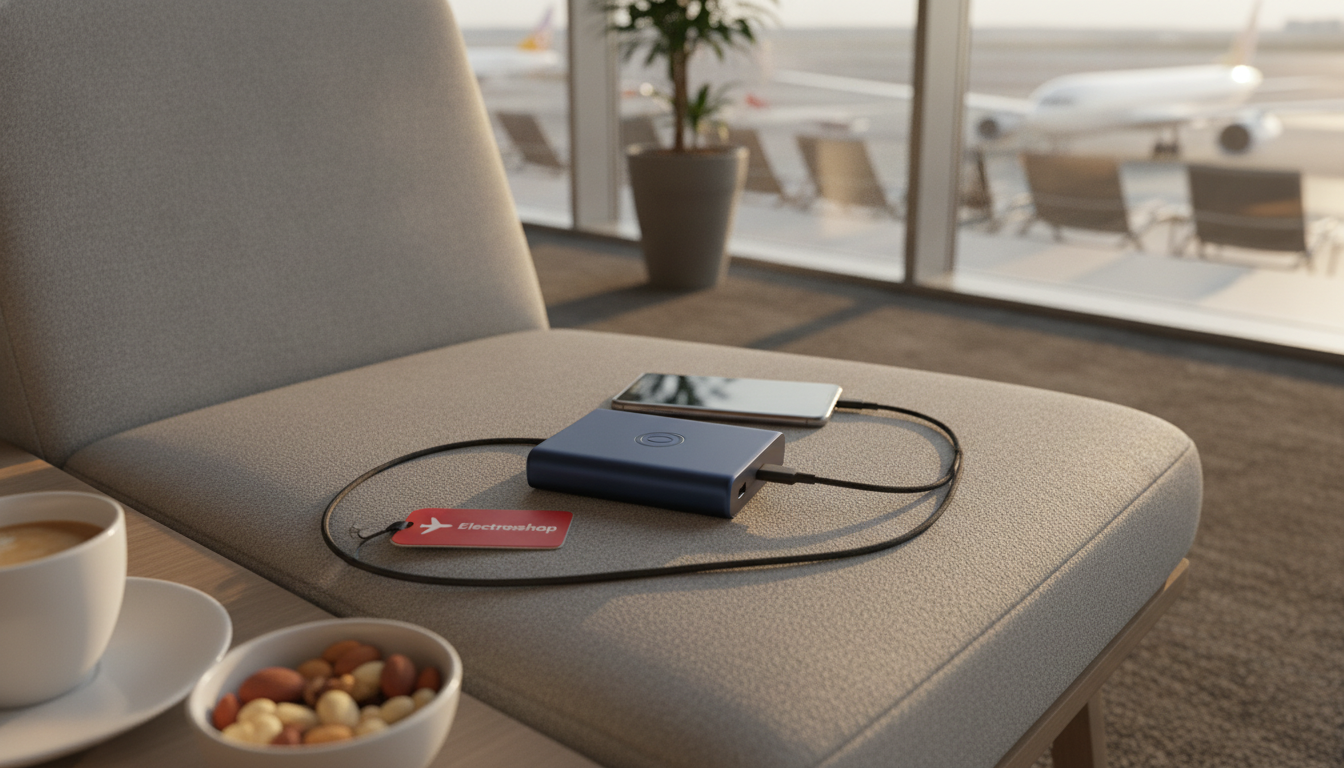
A well-chosen power bank is one of the most practical travel gifts you can give — and one of the easiest to get wrong if you skip the capacity check. Electroeshop carries a wide range of portable charging options across different capacities and form factors, so you can find something that genuinely fits how the person you're buying for actually travels. Check the specs, do the quick math, and you'll have a gift that makes it through security and earns its place in the carry-on every single trip.
If you're also shopping for headphones to pair with a travel kit, our guide on wired vs. wireless headphones covers exactly what to look for based on how someone actually listens.
Frequently Asked Questions
Can I bring a power bank in my checked luggage?
No. The FAA prohibits loose lithium batteries — including power banks — in checked baggage on passenger flights, regardless of capacity. Power banks must always travel in your carry-on bag. If a screener finds one in a checked bag, it will be removed.
How do I know if my power bank is under 100 Wh?
Check the product specs for a listed Wh rating — some manufacturers print it directly on the unit or in the listing. If only mAh is shown, use this formula: (mAh × 3.7) ÷ 1,000 = Wh. A 20,000 mAh bank works out to roughly 74 Wh, which is well within the carry-on limit.
Do international airlines follow the same rules as the FAA?
Not always. The FAA sets the rules for U.S. domestic flights and U.S.-based carriers, but some international airlines have stricter limits — particularly around the 100 Wh range. If the person you're buying for regularly flies international routes, it's worth checking that specific airline's carry-on battery policy before purchasing a high-capacity bank.
Is a 20,000 mAh power bank enough for a long trip?
For most travelers, yes. A 20,000 mAh bank can typically recharge a modern smartphone several times over, which covers a full travel day or a multi-day trip if you top up the bank at your destination each night. If the recipient uses their phone heavily for navigation, streaming, or photography, a higher capacity (still within the 100 Wh limit) gives extra peace of mind without crossing into restricted territory.