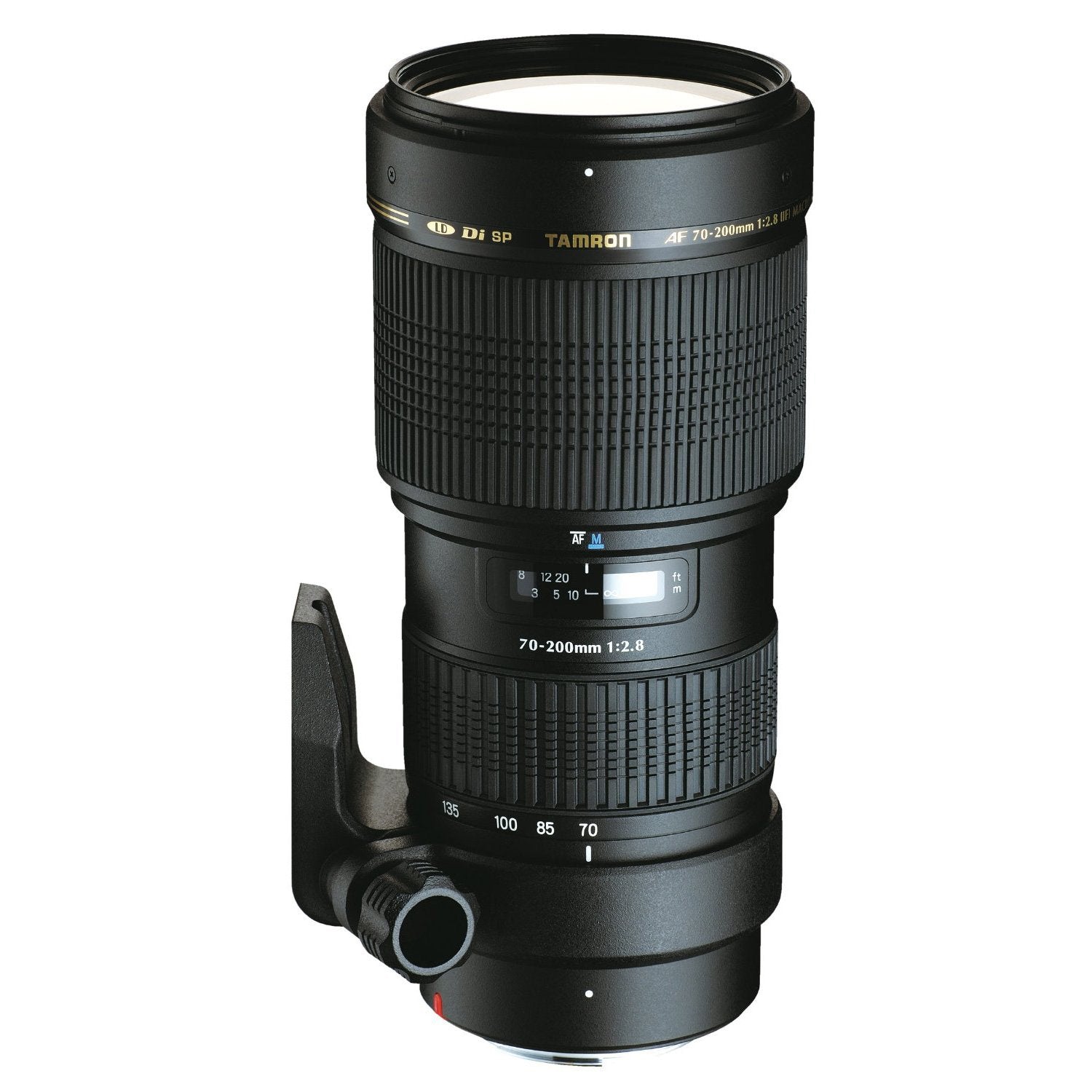
From The Manufacturerthis Exciting New High-Speed, High-Performance F/2.8 Telephoto Zoom For Full-Frame And Aps-C Format Slrs Delivers Outstanding Imaging Performance In A Remarkably Convenient Package Plus Best Close-Focusing Ability In Its Class Down To 0.95M (37.4'') (1:3.1 At 200Mm) Throughout The Range. Its Wide Aperture Permits The Use Of Faster Shutter Speeds In Any Light, And The Effective Use Of Shallow Depth-Of-Field To Achieve Dramatic Pictorial Effects. The Ultimate In Reach, Speed, And Performance For Dual Slr Formats.Sp Af 70-200Mm F/2.8 Di Featureswhile Overall Dimensions Are Confined To The Absolute Minimum, The New Sp Af70-200Mm F/2.8 Zoom Lens Is Packed With Features That Allow Stress-Free Photography: A Versatile Mfd Of Just 37.4'' Over The Entire Zoom Range; Best-In-Class Maximum Macro Magnification Ratio Of 1:3.1 At F=200Mm; And An Advantageous Internal Focusing (If) System. The New Tele-Zoom Lens Covers A Desirable Focal Length Range Of 70Mm Medium Telephoto To 200Mm Telephoto When Mounted On Full-Size Format Slr Cameras And A Focal Length Range From 109Mm To 310Mm* Ultra Telephoto When Mounted On A Dslr Camera With An Aps-C Sized Imager.Digitally Integrated (Di) Lenses For Top Imaging Performancedi (Digitally Integrated Design) Is A Tamron Designation That Applies To Lenses That Have Been Optimized For Digital Capture Using Advanced Multi-Coating Techniques And Optical Designs That Assure Excellent Image Quality Across The Entire Picture Field. Because Of These Characteristics, Di Lenses Provide Outstanding Performance On Cameras With Full-Frame And Aps-C Format Sensors As Well As On 35Mm Film.Low Dispersion (Ld) Glass For Greater Lens Sharpnesslow Dispersion (Ld) Glass Elements In A Lens Help Reduce Chromatic Aberration; The Tendency Of Light Of Different Colors To Come To Different Points Of Focus At The Image Plane. Chromatic Aberration Reduces The Sharpness Of An Image, But Glass With An Extremely Lowdispersion Index, Has Less Of A Tendency To Separate (Defract) A Ray Of Light Into A Rainbow Of Colors. This Characteristic Allows The Lens Designer To Effectively Compensate For Chromatic Aberration At The Center Of The Field (On Axis), A Particular Problem At Long Focal Lengths (The Telephoto End Of The Zoom Range), And For Lateral Chromatic Aberration (Towards The Edges Of The Field) That Often Occurs At Short Focal Lengths (The Wide-Angle End Of The Zoom Range.)Super Performance (Sp) For Discriminating Shooterstamron Sp (Super Performance) Series Is A Line Of Ultra-High-Performance Lenses Designed And Manufactured To The Exacting Specifications Demanded By Professionals And Others Who Require The Highest Possible Image Quality. In Creating Sp Lenses Tamrons Optical Designers Put Their Foremost Priority On Achieving Superior Performance Parameters-They Are All Designed To A Higher Standard With Little Regard For Cost Constraints. As A Result, Tamron Lenses Bearing The Sp Designation Feature Impressive And Innovative Designs That Have Established An Enviable Reputation For Excellence Among Those Knowledgeable Photographers That Demand The Very Best.Internal Focusing (If) Systeminternal Focusing Provides Numerous Practical Benefits To Photographers Including A Non-Rotating Front Filter Ring That Facilitates The Positioning Of Polarizing And Graduated Filters, And More Predictable Handling Because The Lens Length Does Not Change During Focusing. Even More Important, Tamrons Internal Focusing (If) System Provides A Much Closer Minimum Focusing Distance (Mfd) Throughout Its Entire Focusing Range. In Addition, If Improves Optical Performance By Minimizing Illumination Loss At The Corners Of The Image Field, And Helps To Suppress Other Aberrations That Become More Troublesome At Different Focusing Positions.
⚠️ WARNING (California Proposition 65): This product may contain chemicals known to the State of California to cause cancer, birth defects, or other reproductive harm. For more information, please visit www.P65Warnings.ca.gov.
Frequently Asked Questions
Q: What are the dimensions of the Tamron Auto Focus 70-200mm lens?A: The lens measures seven point six four inches in length, three point five four inches in width, and three point five four inches in height.
Q: What materials is the Tamron lens made of?A: The lens features a plastic and metal barrel with a metal mount, ensuring durability and stability.
Q: What is the maximum aperture of the Tamron lens?A: The maximum aperture is F2.8, allowing for excellent low-light performance and depth-of-field control.
Q: How do you use the Tamron Auto Focus lens with a Canon camera?A: To use the lens, mount it securely onto the Canon camera body and adjust the focus using the micromotor-type autofocus system.
Q: Is the Tamron lens suitable for close-up photography?A: Yes, it has a minimum focusing distance of zero point nine five meters, allowing for impressive close-up shots.
Q: What type of filters can be used with the Tamron lens?A: The lens is compatible with seventy-seven millimeter filters, which can enhance images and protect the lens.
Q: How should I care for the Tamron lens?A: To keep the lens in good condition, store it in a protective case and clean the glass with a microfiber cloth.
Q: Is the Tamron lens waterproof or weather-sealed?A: No, the Tamron lens is not waterproof or specifically weather-sealed; avoid exposing it to extreme conditions.
Q: Can the Tamron lens be used on APS-C cameras?A: Yes, when used on APS-C cameras, it provides an equivalent focal length range of one hundred five to three hundred millimeters.
Q: What if the lens arrives damaged?A: If the lens arrives damaged, contact customer support immediately to initiate a return or exchange process.
Q: Does the Tamron lens come with a warranty?A: Yes, the Tamron lens typically includes a limited warranty covering manufacturing defects.
Q: What is the difference between this lens and other telephoto lenses?A: This lens offers a constant maximum aperture of F2.8 and a close focusing ability, making it ideal for both portraits and macro photography.
Q: Is this lens suitable for beginner photographers?A: Yes, the lens is user-friendly and provides excellent image quality, making it suitable for both beginners and experienced photographers.
Q: What common issues should I be aware of with this lens?A: Common issues may include autofocus speed in low light; ensure proper settings for optimal performance.
Q: Can I use this lens for video shooting?A: Yes, the Tamron lens is suitable for video shooting, providing smooth focus transitions and high-quality imagery.