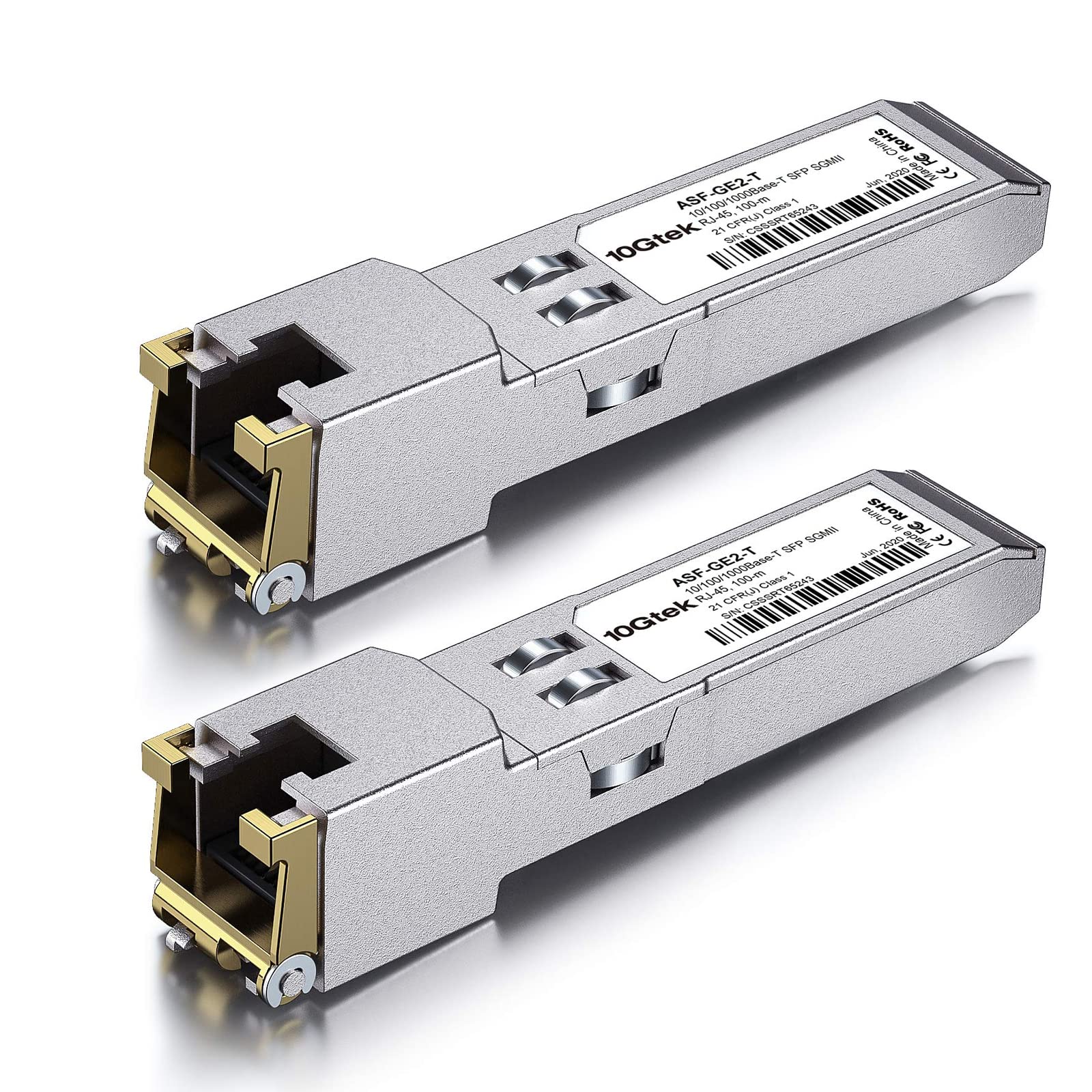
Specifications: Compatible Cisco P/N: Glc-T(10/100/1000)/ Sfp-Ge-T(10/100/1000) 1000Base-T Sfp Transceiver Module For Category 5E Copper Wire, Rj-45 Connector Form Factor: Sfp Data Rate: 10/100/1000M Reach: 100M Fiber Type: Cat5E Ddm/Dom: No Temp. Range(?): 0~70 How To Decide If You Need To Buy A 10/100/1000Base-T Sfp Module Or A Pure 1000Base-T Sfp Module ? 1. Which One To Choose Depends On If The Switch Support Sgmii Interface Or Serdes Interface. Case 1: When The Switch Supports Sgmii Interface, You Need To Choose 10/100/1000 Multi Rate Sfp-T Module. Case 2: When The Switch Supports Serdes Interface, You Need To Choose Pure 1000Mbps Sfp-T Module. Case 3: When The Switch Supports Sgmii Interface And Serdes Interface, You Can Choose Either 10/100/1000 Multi Rate Or Pure 1000Mbps Sfp-T Module. 2. Which One To Choose Also Depends On What Data Rate The Switch Can Support. Case 1: When The Switch Supports 10M/100M, You Can Only Choose 10/100/1000 Multi Rate Sfp-T Module. Case 2: When The Switch Data Rate Supports 1000M, You Can Choose Either 10/100/1000 Multi Rate Or Pure 1000Mbps Sfp-T Module. Case 3: Some Special Switches Can Support Data Rate 10G Or 40G, But Can Backwards Compatible With 1000M Data Rate, You Need To Reset Data Rate To 1000M, Otherwise It Might Not Work Because Of Dismatch.
⚠️ WARNING (California Proposition 65): This product may contain chemicals known to the State of California to cause cancer, birth defects, or other reproductive harm. For more information, please visit www.P65Warnings.ca.gov.
Frequently Asked Questions
Q: What is the data rate of this SFP transceiver?A: The data rate is ten hundred or one thousand megabits per second. This allows for compatibility with various network speeds.
Q: What type of connector does this SFP module use?A: This SFP module uses an RJ-45 connector. It is ideal for connecting to standard Ethernet ports.
Q: What is the maximum reach of this transceiver?A: The maximum reach is one hundred meters. This distance is achievable when using Category five E copper wire.
Q: Is this SFP compatible with Cisco devices?A: Yes, it is compatible with Cisco devices like GLC-T and SFP-GE-T. It is designed to work seamlessly with these models.
Q: What is the form factor of this SFP module?A: The form factor is SFP. This compact design allows for easy installation in compatible equipment.
Q: How do I determine if I need a multi-rate or pure SFP module?A: You should check if your switch supports SGMII or SERDES interfaces. The choice depends on these interface types.
Q: Can I use this SFP with a switch that supports ten megabits?A: No, it is not suitable for switches that only support ten megabits. You will need a multi-rate SFP that includes ten megabit support.
Q: How should I install this SFP transceiver?A: To install, simply insert the module into the SFP slot of your compatible device. Ensure it is securely connected.
Q: What is the temperature range for this SFP module?A: The temperature range is from zero to seventy degrees Celsius. This allows for reliable operation in various environments.
Q: How do I maintain this SFP transceiver?A: Keep the transceiver clean and free from dust. Store it in a cool, dry place when not in use to prolong its lifespan.
Q: Is this product safe to use in home environments?A: Yes, it is safe for home environments as it does not contain hazardous materials. It is designed for typical network usage.
Q: What if the SFP module arrives damaged?A: If the module arrives damaged, contact customer support for a replacement or return. Make sure to keep the original packaging.
Q: What compatibility issues might I encounter?A: Compatibility issues usually arise if the switch does not support SGMII or SERDES. Always verify compatibility before purchase.
Q: How do I clean the SFP transceiver?A: To clean, use a soft cloth and a small amount of isopropyl alcohol. Avoid using abrasive materials that could scratch the surface.
Q: Can I use this SFP with non-Cisco devices?A: Yes, it may work with non-Cisco devices as long as they support the same specifications. Check the device compatibility first.